
Posted 10 February 2025
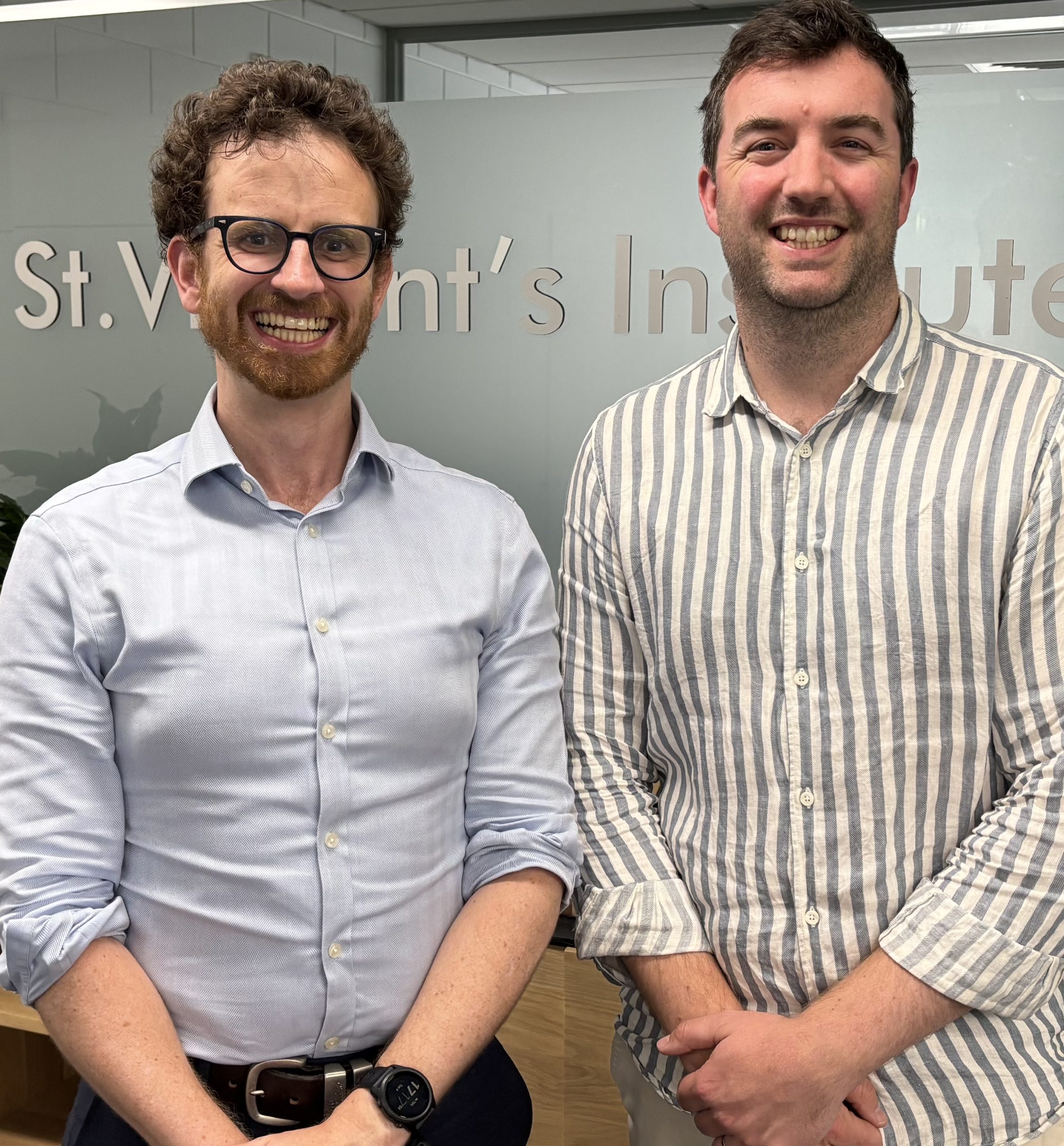
Classmates since year 7, Davis and Jimmy competed at maths and debating. Both have gone on to be international leaders in the fast-emerging field of ‘AI in medicine’.
“He loves rowing whereas I’m cricket, but we have lots in common,” said SVI’s Associate Professor Davis McCarthy.
“Both of us did our DPhils at Oxford at the same time – we were even on the same flight getting there.
“When I heard that Jimmy was visiting Melbourne from the US, I knew that SVI had to invite him to present to our research community,” said Davis.
James Hillis is an Attending Neurologist at Massachusetts General Hospital and Instructor in Neurology at Harvard Medical School. James is also the Director of Clinical Operations for the Digital Clinical Research Organization in Mass General Brigham AI.
At a recent SVI mini-symposium, James outlined his research which focuses on validation studies of diagnostic artificial intelligence algorithms, with studies that he has led being used for over 10 successful device submissions to the US Food and Drug Administration.
“We are at the tip of the iceberg,” said James.
“It is easiest to conceptualise how AI can replicate human tasks, but the more exciting part is how AI can augment medicine through beyond-human tasks.
“AI will be gradually introduced for specific tasks rather than arriving overnight. Medicine is set to involve more consideration of probabilities and a key role for health care providers will be the interpretation of these probabilities for patients,” said James.
James completed his medical school at the University of Melbourne before undertaking a Doctor of Philosophy at the University of Oxford. He subsequently completed the Brigham and Women’s Hospital/Massachusetts General Hospital Neurology Residency Program.
At the event, Davis presented research published in Nature Communications last year. The BRAIx study uses Australian AI capability developed by a team of clinicians, data scientists and engineers, including Davis and his team at SVI, with colleagues from St Vincent’s Hospital Melbourne, BreastScreen Victoria, the University of Melbourne and the Australian Institute for Machine Learning (AIML) at the University of Adelaide.
The algorithm was trained on a data set of 3.3 million breast screen images collected from women who attended the BreastScreen Victoria program between 2016-2019. It has been trained and tested using local data and as a result, offers the highest degree of transparency and trust for Australian use.
“Our ability to develop a state-of-the-art AI reader here in Australia not only highlights the skills and capabilities of our local researchers and institutions but also shows the value of investing in Australia’s capacity for leading AI applications in healthcare.”
“It was fantastic to host Jimmy, and I’m excited that we are now set to collaborate on a project this year,” said Davis.
BRAIx