
Posted 11 December 2025
SVI researchers have made a breakthrough in understanding why children with Fanconi anaemia (FA) develop life-threatening bone marrow failure – while also showing that cutting-edge gene-editing technologies may one day offer a safer, more effective treatment.
The research, published in Blood Advances, focused on a genetic change known to cause FA. For years, scientists have debated whether the disease’s severe symptoms come from a single faulty enzyme or from broader disruptions in the cell’s repair machinery.
According to Associate Professor Andrew Deans, who led the study, his team has now settled that question.
“For decades, the field has questioned whether the devastating effects of Fanconi anaemia come from this one enzymatic failure or from a broader breakdown in the protein complex,” Andrew said.
“Our work shows, unequivocally, that the loss of this single function drives every hallmark feature of the disease – developmental problems, infertility, extreme sensitivity to DNA damage, and the gradual loss of blood-forming stem cells.”
Understanding the precise cause of these symptoms has allowed researchers to test new gene-editing approaches aimed at repairing the underlying genetic mistake. Andrew said the team successfully used both CRISPR-Cas9 and Prime Editing technologies to correct the faulty gene in living tissues.
“Being able to repair the mutation and restore normal cell function is an extraordinary milestone,” he said. “It gives us an ideal platform to test gene-editing therapies that we are now working to translate into patient treatments.”
The project was driven by co-first authors Lu Liu, Astrid Glaser and Abdulsalam Isiaku, in collaboration with researchers across multiple Australian laboratories, and supported by Maddie Riewoldt’s Vision (MRV).
Victorian Government backs push toward a world-first clinical trial
The breakthrough comes as the Victorian Government reaffirms its support for SVI’s efforts to develop RNA and gene-editing therapies for rare childhood diseases.
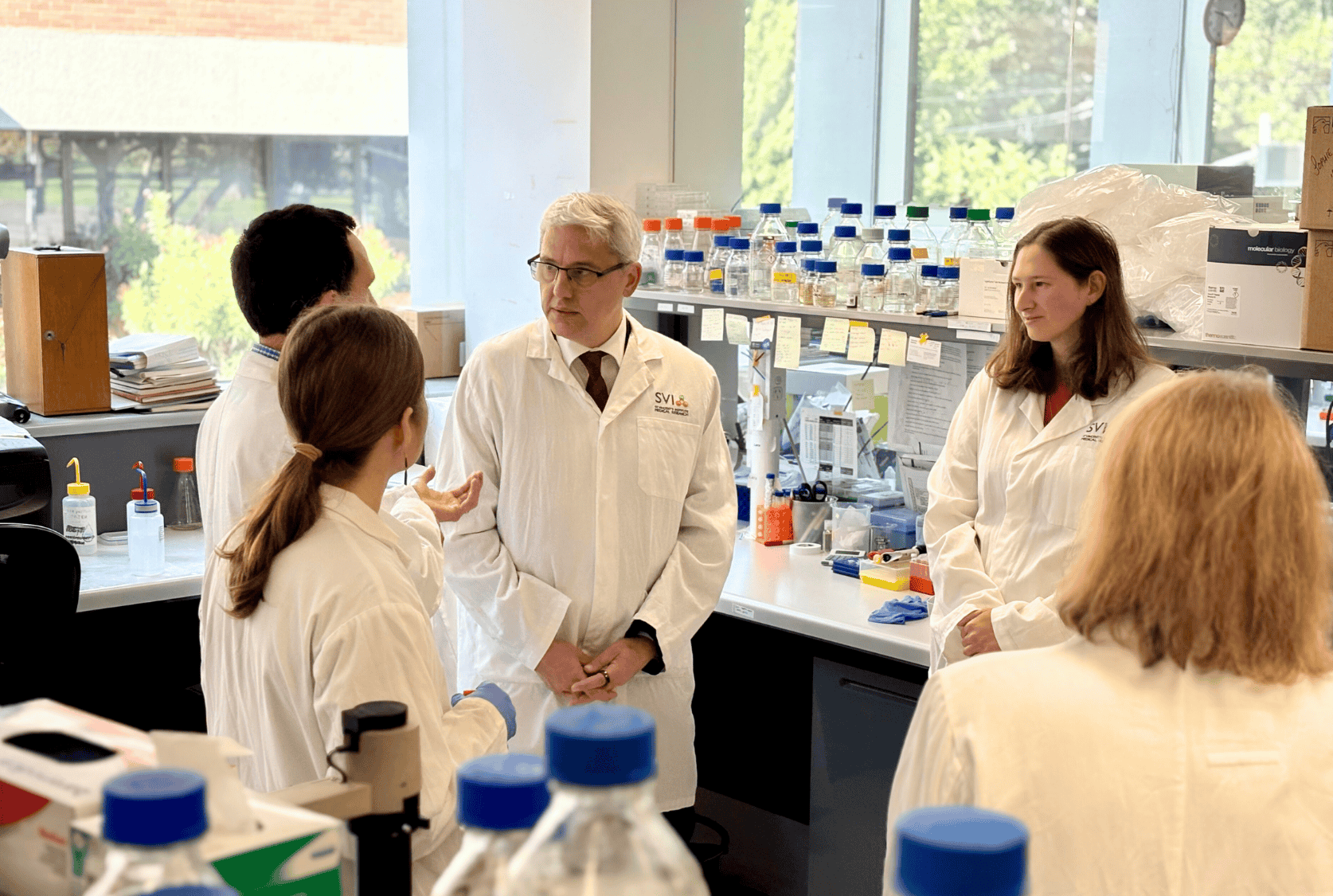
During a visit to SVI – which was covered by Channel 9 news – Minister for Economic Growth and Jobs Danny Pearson met Andrew, the research team and patient-advocate Amelia Hawkshaw to learn how these new technologies could one day eliminate the need for bone marrow transplants – currently the only treatment for many children with FA.
Prime Editing, one of the newest and most precise gene-editing tools, is at the centre of this push.
“Prime Editing allows us to correct the FA mutation with exceptional accuracy,” Andrew said. “If we can deliver this safely into patients, we could avoid the need for risky and expensive bone marrow transplants altogether.”
Fanconi anaemia is a rare genetic disorder that affects around 190 young Australians. Children often face developmental difficulties and progressive bone marrow failure, and more than half will die from the disease or its complications.
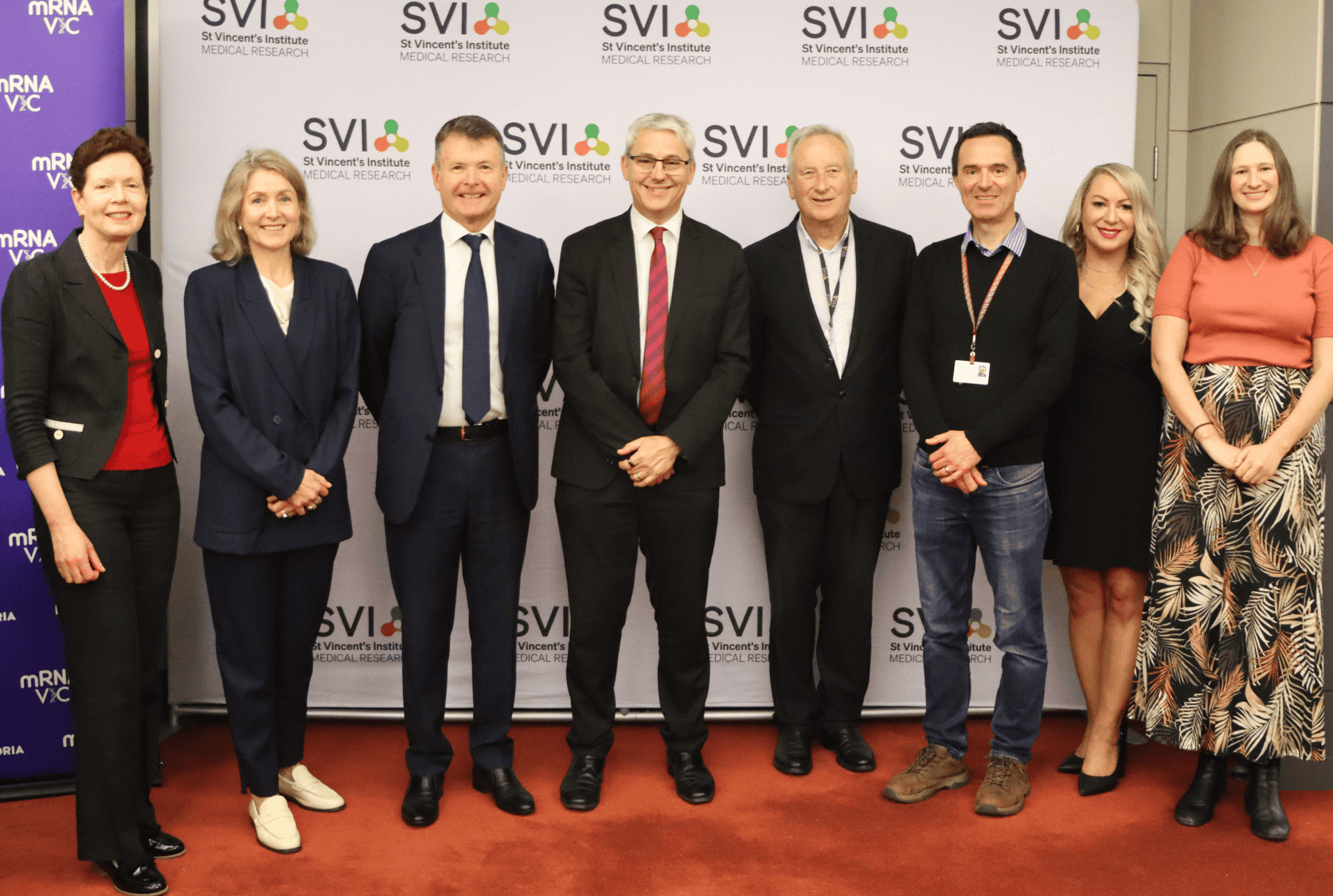 The project is being delivered in close partnership with Maddie Riewoldt’s Vision, Australia’s only dedicated organisation for bone marrow failure syndromes. The collaboration ensures that patients and families help shape the development of the therapy as it moves toward what could become a world-first clinical trial.
Minister for Economic Growth and Jobs Danny Pearson said:
“It’s exciting to see this research rapidly advancing towards clinical trials, offering real hope for children and families battling these devastating diseases.
“Our medical research and health technology sector is the largest sector in Australia – supporting more than 30,000 jobs and enabling Victorian scientists to change lives around the world.”
SVI Director Professor Tom Kay emphasised the importance of government investment:
“Investment in medical research gives SVI scientists the best chance of maximising new mRNA technology to develop leading-edge therapy to combat rare childhood diseases like Fanconi anaemia.”
Amy Coote, CEO of Maddie Riewoldt’s Vision, highlighted the impact on families:
“Maddie Riewoldt’s Vision is thrilled to partner with SVI on this groundbreaking project. We’re incredibly grateful for Andrew Deans and his team’s commitment to patient and family engagement, and thankful for the Victorian Government’s investment in advancing gene editing technology that offers real hope for those living with bone marrow failure syndromes.”
Andrew said the momentum behind the research marks a turning point for children affected by FA.
“This level of collaboration – across research institutes, government, and patient families – is what will make gene-editing therapies a reality,” he said. “We are closer than ever to delivering treatments that could dramatically change lives.”
Read the full paper in Blood Advances